|
Click
here to
listen to an audio presentation
of this podcast
TRANSCRIPT
Stevie Black: This is Stevie
Black with McDougall Interactive
and today I'm sitting down with
Dave Mouradian of Melrose Oriental
Rugs located in Melrose, Mass.
We're going to discuss rugs
and carpets and how to buy a
rug. So Dave, when a customer
walks in your front door what's
the first question that they
typically ask?
Dave Mouradian: Well, typically
when a customer walks in the
door they don't know much about
oriental rugs. They want me
to give them a brief history
about oriental rugs and they
want to learn about quality.
That's my favorite customer.
Knowing the quality and knowing
how a rug is made and knowing
what makes a good rug from a
bad rug, those are critical
things to know when purchasing
an oriental rug.
Stevie: So quality is job number
one, as they say. What are some
of the indicators that delineate
a good rug from a bad one?
Dave: There are three main
things that you need to look
for when you are buying an oriental
rug. Many people that know very
little about oriental rugs what
they tell you to do is look
at the back of the rug and see
how tightly woven it is. That's
usually the first question or
comment that people have: is
it tightly woven or not tightly
woven? Well, that's very important
part of the quality, but there
are other things that are also
important, like the quality
of the wool. Sometimes when
you have a tight weave rug,
they don't use as much wool
in each knot so it can look
like it's a very tightly woven
rug, but the way the knot is
constructed, it's not as tight
as it feels. That's why really
the most important thing that
we try to teach people is to
feel for the density - how quickly
can you work your thumb from
the front of the pile into the
back of the pile and knowing
that it's going to last a long
time and have a good density.
It's not the thickness, because
sometimes poorly woven rugs
are very thick and sometimes
very finely woven rugs are thin.
Not that, but how quickly can
you get your thumb working into
the back of the rug. That's
the density. That's what we
try to push people into as an
important factor.
Stevie: Why do you think that
quality is one of their primary
concerns? Is it because of the
industry rug buying in general
perception of the public or
is it because they feel like
a rug is an investment. Therefore,
they need to really be aware
of high end, middle end and
low end?
Dave: I think that's exactly
it. People when they walk in
the door and they are trying
to decide which type of rug
they are going to buy, a machine
made rug or a hand made rug
or a hand tufted rug. They know
there is a lot of price differences.
If they are going to buy a hand
made rug, what makes it so much
more expensive than the other
options and why is it important
to buy this type of rug?
Stevie: You mentioned hand
tufted, hand woven. What are
the differences between those
different styles of weaving?
Why are they important in terms
of the value of the carpet?
Dave: The more hand made and
hand knotted it is the more
work that is put into the rug.
It takes a lot longer and costs
a lot more to do that. A hand
tufted rug, you can go out today
to most Oriental rug stores
and they have what's called
hand tufted oriental rugs. When
you look at the face, it looks
exactly like a hand knotted
Oriental rug. It's when you
look at the back and you see
the material on the back of
the rug and what that material
is doing is it's just hiding
the glue. These rugs are just
glued together. They have a
tufting gun where the shoot
the wool in through the back
of the rug. They put a latex
adhesive and a piece of burlap
or cotton material to hide that
and it makes it look nice and
neat. The face looks like the
same, but in the long run it
is just a glued together rug
and over a period of time, it's
going to fall apart or the glue
dries out. That's one of our
biggest problems when we see
those types of rugs. They come
in for cleaning. We try to explain
to people that this is not a
hand knotted rug, it's a hand
tufted rug and that's where
a lot of times the glue dries
and the rugs break apart over
a shorter period of time.
Stevie: Rugs are also made
out of different kinds of materials.
There's obviously wool, but
there are some cottons. There
are silks. There are other kinds.
Do you see much of that in your
own particular business? And
do you steer people away from
certain kinds of materials,
based on traffic or where it
is in the house?
Dave: We definitely try to
steer people. We just sell wool
oriental rugs. Sometimes they
can have some silk highlights
or silk flowers in them, which
add to their beauty. But in
general wool is the best. But
within wool there are a lot
of different qualities of wool.
Sometimes you have a drier wool,
depending on where the wool
was from, where the sheep were
grazed. What part of the sheep
does the wool come from? These
are all important factors when
they use the wool. The shoulder
of the sheep is a lot more durable
or the belly of the sheep where
the sun doesn't shine on it
as much. Those have more lanolin.
The more lanolin in the wool
the better, because it makes
the rug wear less because it
is more flexible.
Stevie: In you opinion is there
one country or one region that's
making the better rugs and other
countries that are notorious
for making more inferior rug
products?
Dave: That's a very much a
question that people use all
the time. I hear that question
every day. People think about
their grandmother and you have
to own a Persian rug or a rug
made in Iran. That's the same
thing. Years ago that was the
truth. Persian rugs, they made
the best rugs. When these countries
like India, China and Pakistan
started weaving rugs they weren't
doing a very good job. But over
the years have progressed they
have made better and better
quality rugs, more tightly woven.
They use better products. They
make better designs. Nowadays,
the Persian rugs, many times
they are the lowest quality
rugs. When I go to the market
to buy rugs, they're more pushing
these lower quality Persian
rugs because they want to try
to fool people because it has
a Persian tag on it. People
just assume that it's a really
good rug. But in reality, each
one of these countries makes
very, very good rugs. And they
all make very bad rugs. Again,
it goes back to quality, looking
at the tightness of the weave,
the quality of the wool, but
more importantly the density
and the construction, not buying
a hand tufted, but a hand knotted
rug.
Stevie: Ultimately, Dave, as
much as you could explain all
this to your customers, the
customer standing in your store
looking for a rug for the living
room or the dining room, what
have you, maybe a runner on
the stairs. So maybe you can
tell us just a little bit about
your process. Explain the steps
that you take to introduce a
customer to the various kinds
of rugs and how you go through
the process of finding the right
piece for their house.
Dave: Well, of course the first
most important step is either
to give us a call or to email
me and we'll be in contact.
The second step is for me to
come to your house. That is
where it makes things so much
easier. If we start from the
beginning and I come to your
house and we talk about the
size and I look at your colors.
I look at the window lighting
or how your furniture is set
up. We go back and forth and
you explain to me the purpose
of the rug. If it's a family
room rug and you want a rug
that is going to be durable
or a rug that's going to be
in a second bedroom that you
don't need to be as finely woven
or as good of quality. We go
through all these different
questions so that we can get
to the next step in the process,
which would be me coming back
to your house, bringing the
different sizes up. Then you
come to the store and then we
bring the rugs to your house.
You get to live with them for
a period of time. This is a
process that works best for
us and you, the customer.
Stevie: Now, I've heard you
talk before that many people
buy a rug that is the wrong
size. And from what I understand
that's a fairly avoidable mistake.
How do you help your customers
avoid making that mistake?
Dave: Well, again, with the
home visit it makes it not a
problem. Many times people for
a dining room go buy the wrong
size or for the living room.
What we do is look at your situation.
You want to make sure in a dining
room when you back up the chairs
the chairs stay on the rug.
Or in a hallway you want to
make sure that a rug is not
going to end in the middle of
a doorway. In an office you
want to make sure that the rug
is big enough so that the chair
stays on the rug when you pull
it back. These are all important
things that we can get over
with quickly while I'm at your
house, rather than coming to
the store and finding that the
perfect rug that you love being
the wrong size.
Stevie: Now, we've talked a
little bit about size. We've
talked a little bit about quality
of the wool of the rug and the
densities and these kind of
issues. Maybe you could talk
a little bit about what the
best way is to determine what
color the rug should be.
Dave: Well, again it's going
to be me coming to your house
and looking at what you have
for lighting, what you have
for wall color and what you
have for furniture, material
in your sofa and your chairs.
The easiest is to come and purchase
the rug first. And the rug is
something that you are going
to have for a lifetime. The
draperies, the wall color, the
furniture, that will change
over a period of time. We pick
a rug that you love and you
build from there. You build
and you say, I want to pull
this little bit of blue out
for a chair. Or I want to pull
this burgundy out for some pillows
on my couch. Those are different
ways which we can help you go
in the right direction for color.
But trying them in your house.
We've had people come in. I
was just in Reading the other
day and they didn't know what
color they wanted. So we brought
a light color. We brought an
ivory background. We brought
a red background. And we brought
a black background. They got
to live with it and got to see
it in the daylight and they
got to see it at night. The
way the windows were it wasn't
a sunny side of the house. They
decided that they wanted that
ivory background with a black
border and they were going to
have a green sofa. The walls
were a tan/gold color and it
looked beautiful when we were
done. But that's the process.
By trying different things,
seeing them in your house, that's
when you make the right decision.
Stevie: So, yeah, I can see
how the side of the house that
doesn't have sun how the black
carpet probably, even if it's
what they may have had in their
mind's eye, might not have worked
out so well in practical use.
Speaking of practical use, what's
the most common example of people
buying "too much rug"
for the situation?
Dave: Well, when you say "too
much rug" in the size,
that would mean like a lot of
times people in a bedroom, they
want to buy the rug for the
whole room. They want to get
out of the bed on both sides
of the bed and be standing on
the rug to keep their feet warm.
But putting a rug under a bed
is one of the worst things you
can do. That's probably the
most often place we find moths,
under beds. Because bedroom
rugs don't get dirty. So it
takes so long for you to actually
move the bed and turn the rug
or bring the rug in for cleaning
it gives the moths a chance
to dig in. they start eating
and before you know it you're
having a problem in your whole
house. But a lot of times people
can use the term "too much
rug" for too much quality,
too. Like you want to get the
better quality rugs where they
get the highest usage. This
is a common problem that people
have. They have these living
room/dining rooms that no one
goes into and they want to put
the best rugs there. They have
the family room where the dog
is in there, the kids are in
there, and they use it every
day, all day long, and they
want to put a rug... I don't
want to put a good rug where
we are every day. It will get
ruined. Well, it's really the
opposite. This is pretty important
that you put the best rugs where
they get the most use because
they last the longest. They
are indestructible. You want
to put the finest rug where
they have the fine silver and
the china, but no one goes into
that dining room three times
a year. It's not necessary to
put the finest rug in that room.
You want to put it in that family
room and then it will just last
forever.
Stevie: That's a really good
point and something that my
mom learned very early on. She
bought a number of rugs for
the house and she always put
the top quality rug right in
the living room where everybody
came and went. And it's still
there, 40 years later it's still
the same carpet. So I agree
with you there. Now, you talked
a little bit about the bed on
top of the rug. It's not getting
moved around. And probably pests,
it's a good spot for pests like
moths to get in there and start
to do damage to that rug. Are
there any other places that
furniture can cause those kinds
of problems?
Dave: Well, moths like dark,
still areas. So the biggest
problem that we find is when
people have a piece of furniture
where the actual wood goes right
to the floor all the way around.
A lot of times a dining room
hutch, if you get a rug that's
too big for your dining room
and you have the hutch that
sits on that corner of the rug...
I've actually went to a house
in Melrose the other day that
we didn't see. We went to pick
up the rugs for cleaning. We
didn't see a moth anywhere.
This house was crystal clean.
I mean, it was unbelievable.
We moved this corner of the
hutch and the actual space where
the hutch was on top of the
rug was completely gone. All
we saw was the foundation of
the rug. The foundation is made
out of cotton, typically. So
the moths don't eat the cotton,
they eat the wool. And the whole
little corner of the rug was
completely gone and the rest
of the rug was completely clean
of moths. It was the dining
room where they use it three
times a year. It's not necessary
to clean it as often or turn
it as often. And we went to
move it and it was completely
infested.
Stevie: Wow.
Dave: So just to back up again.
Any room that you just want
to try to avoid to put furniture
that goes right to the floor,
like that doesn't let any air
or light or movement to the
rug. That's when moths will
come.
Stevie: It's good advice for
sure. Speaking of advice, now
once the customer has come to
a conclusion about the size,
shape, color or a carpet that
they are interested in, do you
have all these kinds of carpets,
all these sizes, all these colors
in your own inventory? And if
not, how do you approach those
issues?
Dave: Well, just on the way
here I stopped at a house in
Andover where they called me
up to the house, asked me what
size they needed. I had suggested
a 12 foot round. And 12 foot
round is not a very common rug.
I had one in my stock. It was
the wrong color that I thought
was appropriate for them. But
I wanted to bring the size.
So I brought the size over and
husband or the wife they had
agreed upon the size. What I
did was, when I go to the market
where you buy the rugs, I go
to about 20 to 30 different
importers. So I'm doing the
shopping for you. And I know
what kind of colors and designs
that you are looking for. I
can bring you back a selection.
What I ended up bringing was
four different 12 foot rounds,
which are virtually impossible
to find. We put it in this room
and they ended up choosing one
of the rugs. So, I do the shopping
for you. It's no obligation.
It's just that I can go, after
being to your house, after talking
to you about colors, and talking
about size, we can go and give
you a selection of something
that would be as difficult as
a 12 foot round.
Stevie: Now, you have talked
about your in home consultations.
That is free of charge?
Dave: Yes. Absolutely.
Stevie: Now, is it common that
people will in that first consult
visit ask you to come in and
talk about one room or one situation
where they want a carpet and
begin to build a wish list for
other areas in the home?
Dave: Sure that's one of the
things we will do first over.
We'll look at all the different
areas throughout the house they
are thinking about an Oriental
rug, stairs, hall, living room,
dining room, wherever they have
a need for a rug. We'll go and
we'll talk about size and placement.
They'll write all these things
down, so that when they become
ready for these rugs they'll
at least have the size ready
to go. But yeah, they'll zero
what I would always try to suggest
doing one room at a time. And
then we can build from there.
Stevie: Dave, it sounds like
the thousands of home visits
that you've made have given
you the unique ability to understand
unique patterns and needs of
any household. In the many years
that you've been in this business,
you've developed a gift for
finding the right solution for
each individual challenge. Now
that customer has bought an
oriental rug, what's the best
way for them to protect their
Oriental rug investment over
time?
Dave: Well, proper maintenance
is important. Of course, when
you buy a rug from us, we're
going to make sure you have
the correct type of underlayment,
the correct padding for the
usage. And we'll explain to
you when we come to your house,
when we see the area, if it's
the family room I'll probably
say, this is an area where you
should rotate your rug. This
is an important thing that never
gets done with people. I see
it all the time when people
bring their rugs in for cleaning.
One end of the fringe is completely
worn. The other end is brand
new because they had it under
a couch or in an area that didn't
get use. It's important to rotate
your rugs periodically. So maybe
in an area like a family room
you rotate it every two years,
maybe clean it every four years.
Each individual situation is
different. Also with the type
of rug, certain types of rugs
need to be cleaned more often
if they are more loosely woven.
They are more susceptible to
wear with the grit and the fine
particles that get to the bottom
of the pile of the rug. The
other thing that people do often
is they use the vacuum on the
fringe of their rug. That's
something that we try to tell
people to avoid. The fringe
is only made out of cotton in
most cases. And by vacuuming
it up, it chews the fringe up.
Over a short period of time
that can be worn off. It can
be sewn on again, but it's never
like the original because the
original is part of the foundation
of the rug.
Stevie: Now, you and I talked
before about hand washing. I
guess for our listeners, can
you take it to anyone and get
a rug hand washed?
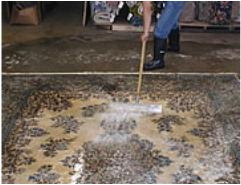
Dave: No. there's very few
people that clean oriental rugs
the correct way. The most important
thing is turning the rug upside
down, vibrating or knocking
the dirt loose and then you
can give it a hand washing.
These guys that drive around
in trucks, most often... You
open the book and look on the
Internet everyone is an expert
on oriental rug cleaning. Well,
most of these guys they just
clean the surface and that's
the end of it. You get a surface
cleaned rug but deep down dirt,
deep grit is still in the rug.
Stevie: So now you are telling
us that you clean you rugs on
the premises at your store at
your location.
Dave: Right. Probably about
75% of the rugs that we do we
do right in our actual location,
but we do have a warehouse the
next time over that we do some
of the cleaning also. It's our
own warehouse, but it's just
that we do some of the larger
rugs that need special attention
we do over there. Each rug comes
in and we pick up rug. It's
all individual. It's not like
it just puts it in a big pile.
Whatever the rug needs to be
done the right way we do it.
Stevie: Now are there any other
pitfalls to be aware of when
trying to protect your investment,
repair, any other items?
Dave: Sometimes we see people
that if they have a lot of strong
window light, they got to be
careful. Any rug will fade over
a period of time, depending
on the sunlight so you have
to be aware of that. If you
see any loose strings or things
starting to get worn you want
to address those quickly so
that it doesn't get worse. You
want to always make sure you
have the proper padding under
the rug so.
|